Commercial spaces today are designed very differently compared to a decade ago. Offices are becoming more open, retail stores focus heavily on customer experience, restaurants prioritize ambience, and hotels invest deeply in comfort-driven interiors. In all these spaces, air conditioning is no longer treated as just a cooling appliance. It has become a part of how people experience a space.
This is exactly why the daikin 4 way cassette air conditioner has become one of the most preferred commercial cooling solutions across modern businesses.
Most people assume cooling problems happen because an AC is not powerful enough. In reality, commercial cooling issues are often caused by something much deeper — poor airflow planning.
You may have experienced this yourself:
- one side of an office feels extremely cold while another feels warm,
- customers avoid certain seating areas in restaurants because airflow feels uncomfortable,
- meeting rooms become stuffy even when the AC is running continuously,
- or employees sitting far from the indoor unit constantly complain about uneven cooling.
These problems are common in commercial spaces because traditional air conditioning systems were never designed to manage large open environments efficiently.
A cassette AC system changes this by focusing not only on cooling capacity but on how conditioned air moves throughout a space.
And that is the real reason businesses are increasingly choosing cassette systems over conventional wall-mounted units.
Why Commercial Cooling Requires a Different Approach
In homes:
- the number of occupants usually remains limited throughout the day,
- room layouts are simpler and easier to cool evenly,
- and temperature variations are relatively stable compared to commercial environments.
Commercial spaces operate in a far more dynamic environment.
An office may contain:
- large teams working continuously across multiple workstations,
- computers and electronic equipment generating additional indoor heat,
- glass cabins and partitions that trap temperature more quickly,
- and constant employee movement throughout the day.
Retail stores deal with:
- strong lighting systems that increase indoor heat levels,
- changing customer density during different business hours,
- and frequent door openings that affect indoor temperature stability.
Restaurants and cafes experience constant temperature fluctuations because of kitchens, crowded seating arrangements, and long operational hours.
In such environments, simply installing a high-tonnage AC is not enough.
The real challenge is maintaining balanced comfort across the entire space without creating:
- sections that feel warmer than the rest of the room,
- excessive airflow concentrated toward one particular area,
- humidity imbalance that makes the environment feel uncomfortable,
- or unstable temperatures during continuous operation.
This is where the daikin 4 way cassette air conditioner becomes valuable because it is designed specifically for larger and more demanding commercial environments.
Understanding How a 4-Way Cassette AC Actually Works
One of the biggest misconceptions people have is that all AC systems cool in the same way. They do not.
Traditional split ACs push air from a single direction. This works reasonably well in smaller residential rooms but becomes less effective in commercial environments where air needs to travel across wider layouts.
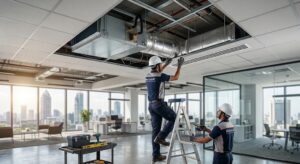
A cassette AC is installed within the ceiling and distributes conditioned air in four directions simultaneously. Instead of concentrating airflow toward one section, it spreads cooling evenly across the room.
This creates a more balanced indoor environment where:
- temperatures remain stable,
- airflow reaches multiple corners,
- and cooling feels more natural rather than concentrated.
The impact of this is far greater than most businesses initially realize.
For example, in an office environment, uneven cooling can quietly affect productivity. Employees sitting in warmer areas often feel discomfort and fatigue faster. In retail stores, customers may unconsciously avoid sections that feel stuffy. In restaurants, poor airflow can affect the dining experience even when the food and interiors are excellent.
Comfort is psychological as much as physical.
People may not always notice when cooling is perfect, but they immediately notice when it feels uncomfortable.
That is why airflow design matters just as much as cooling capacity.
Why Airflow Matters More Than Tonnage
Many businesses select commercial AC systems based purely on tonnage. While cooling capacity is important, airflow distribution is what determines how effectively that cooling is experienced.
Imagine pouring water into only one side of a garden and expecting the entire area to become evenly wet. That is exactly how poor airflow behaves in commercial spaces.
Even a powerful AC may struggle if conditioned air is not distributed correctly.
A properly designed cassette AC system helps solve this by circulating air more uniformly throughout the room. This reduces:
- uneven cooling,
- stagnant air pockets,
- and excessive temperature variations.
This is especially important in commercial environments where people are spread across multiple seating zones.
In Mumbai’s humid climate, airflow becomes even more critical because humidity often makes indoor spaces feel warmer than they actually are. Efficient air circulation helps improve overall comfort without constantly lowering the temperature.
This is one reason businesses searching for a Daikin cassette air conditioner in Mumbai often prefer cassette systems for medium and large commercial interiors.
Why Modern Commercial Interiors Prefer Cassette AC Systems
Commercial interiors today are designed around space efficiency and aesthetics. Businesses invest heavily in creating interiors that look modern, open, and visually clean.
Traditional wall-mounted ACs often interrupt this design flow because they occupy visible wall space that could otherwise be used for:
- brand signage and visual identity elements,
- product display sections and merchandising layouts,
- decorative or functional lighting installations,
- artwork and interior design features,
- or additional storage and utility planning.
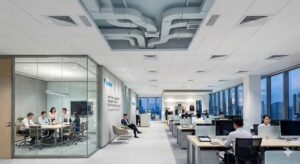
A cassette AC solves this problem by remaining concealed within the false ceiling. Only the front panel is visible, allowing the interior to maintain a more premium and uncluttered appearance.
But aesthetics are only one part of the advantage.
Ceiling-mounted cooling also improves air distribution because cool air naturally spreads downward and outward more efficiently from an elevated position.
This makes cassette systems particularly effective in:
- office environments with multiple seating zones and cabins,
- retail showrooms that require consistent customer comfort across open layouts,
- conference rooms where balanced airflow improves meeting comfort,
- hospitality spaces that prioritize both ambience and cooling consistency,
- and clinics where clean interior appearance and stable comfort are equally important.
For businesses, this combination of functionality and aesthetics creates both operational and experiential value.
Choosing the Right Capacity for Commercial Spaces
One of the most common mistakes businesses make is assuming that larger tonnage automatically means better cooling.
Commercial HVAC planning is far more technical than that.
Cooling requirements depend on:
- occupancy load,
- ceiling height,
- sunlight exposure,
- equipment heat generation,
- ventilation,
- glass surfaces,
- and operational duration.
For larger commercial environments, a daikin 4 ton cassette ac is often considered because it can handle higher cooling loads more effectively. However, oversizing a system can sometimes create problems such as:
- excessive electricity usage,
- rapid cooling cycles,
- and poor humidity control.
Undersized systems create the opposite issue by continuously overworking to maintain temperature.
The goal is not simply to install the largest AC possible. The goal is to create balanced and sustainable cooling performance.
This is where proper HVAC planning becomes essential.
The Hidden Impact of Energy Efficiency
Most businesses think about energy efficiency only in terms of electricity savings. But efficient cooling affects much more than monthly utility bills.
An energy-efficient system:
- maintains more stable temperatures,
- reduces strain on internal components,
- improves long-term reliability,
- and creates more consistent comfort.
Modern cassette systems use inverter technology that continuously adjusts compressor performance according to actual cooling demand instead of constantly switching ON and OFF.
This creates smoother operation while reducing unnecessary power fluctuations.
For commercial spaces operating for long hours every day, this difference becomes significant over time.
Efficient airflow also contributes to lower operational costs. When air reaches every corner properly, the system does not need to work aggressively to maintain indoor comfort.
Common Commercial Cooling Mistakes Businesses Make
Many commercial cooling problems are not caused by equipment failure but by poor planning decisions.
One common mistake is improper AC placement. Even a high-quality system may struggle if airflow gets blocked by:
- partitions,
- lighting structures,
- ceiling beams,
- or interior layouts.
Another mistake is ignoring occupancy patterns. A conference room used occasionally requires different cooling planning compared to a continuously occupied office floor.
Businesses also often delay maintenance until problems become visible. By that stage:
- airflow efficiency drops,
- energy consumption rises,
- and cooling consistency reduces.
Commercial HVAC systems perform best when installation, airflow planning, and maintenance are treated as interconnected factors rather than separate tasks.
Why Maintenance Determines Long-Term Performance
Commercial AC systems operate for much longer durations compared to residential systems. Over time, dust accumulation, blocked filters, and neglected servicing slowly reduce airflow quality and cooling efficiency.
Preventive maintenance is not just about avoiding breakdowns. It directly affects:
- how efficiently air circulates throughout the commercial space over long operational hours,
- the ability of the system to maintain stable and balanced cooling performance,
- overall electricity consumption and long-term operational efficiency,
- and the lifespan of critical internal components within the HVAC system.
Simple servicing practices such as:
- regularly cleaning filters to prevent airflow restriction,
- inspecting drainage systems to avoid leakage and moisture buildup,
- monitoring airflow performance across different sections of the space,
- and scheduling periodic professional servicing for internal system inspection
help maintain stable long-term performance.
Businesses often focus heavily on purchasing the right AC system but underestimate the importance of maintaining it properly afterward.
Why Cassette AC Systems Are Becoming More Popular in Mumbai
Mumbai presents unique cooling challenges because of:
- humidity,
- crowded commercial environments,
- extended operational hours,
- and year-round cooling demand.
Businesses therefore require systems that can maintain:
- consistent airflow across larger commercial interiors without creating uneven cooling zones,
- stable indoor comfort even during long operational hours and changing occupancy levels,
- energy-efficient performance that helps reduce unnecessary electricity consumption,
- and reliable long-term cooling operation in demanding commercial environments.
This is one reason demand for daikin cassette 4 way ac in mumbai continues to grow across commercial sectors.
Businesses today understand that indoor comfort directly influences:
- how comfortably customers spend time inside commercial spaces,
- employee productivity and workplace concentration,
- the shopping and dining experience in customer-facing environments,
- and the overall experience people associate with a business environment.
Cooling systems are no longer treated as background utilities. They are part of the business environment itself.
Final Thoughts
A daikin 4 way cassette air conditioner is not simply designed to cool a room. It is designed to improve how commercial spaces function and feel.
Its real value lies in:
- balanced airflow,
- unobtrusive installation,
- efficient cooling distribution,
- and long-term operational comfort.
Whether it is an office improving employee productivity, a restaurant enhancing customer comfort, or a showroom creating a better shopping environment, the quality of cooling quietly shapes how people experience that space every day.
However, even the best commercial HVAC system performs efficiently only when it is properly planned, correctly installed, and suited to the specific requirements of the space. Factors such as airflow design, occupancy, ceiling structure, and cooling load all play an important role in long-term performance.
This is where experienced HVAC expertise becomes valuable. Businesses looking for a reliable Daikin cassette air conditioner in Mumbai can benefit from working with professionals like BeCool AC, who understand the practical challenges of commercial cooling and help businesses choose solutions that balance comfort, efficiency, and long-term reliability.
Because in commercial environments, effective cooling is not just about temperature control — it is about creating a space where people can work, shop, dine, and interact comfortably throughout the day.