
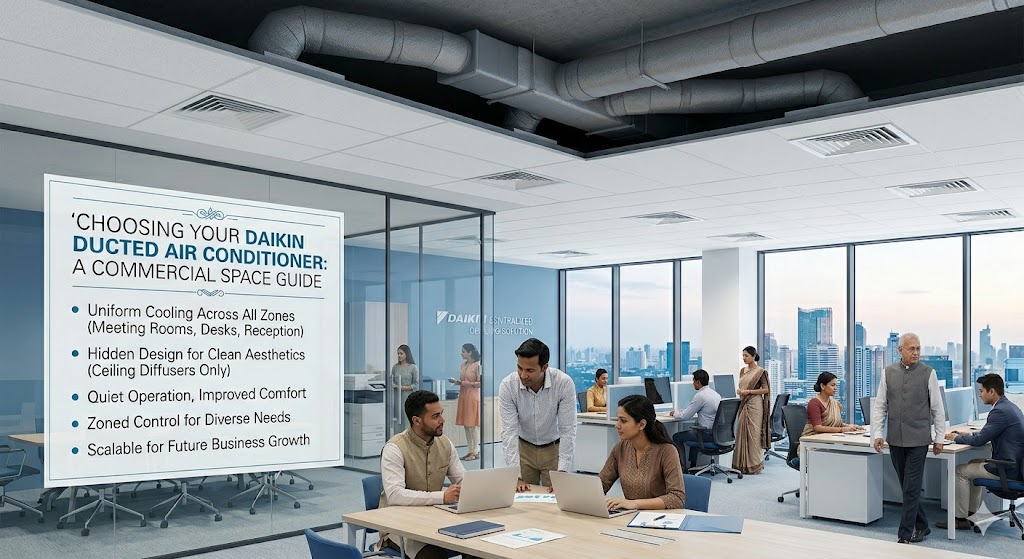
Choosing an air conditioning system for a commercial property is about more than keeping indoor spaces cool. The right system can influence employee comfort, customer experience, operational efficiency, and long-term energy costs. As businesses grow and commercial spaces become more sophisticated, many property owners are moving away from multiple standalone air conditioners and exploring centralized cooling solutions.
Among the available options, a Daikin Ducted Air Conditioner has become a preferred choice for offices, retail stores, healthcare facilities, hotels, educational institutions, and other commercial environments. These systems are designed to deliver consistent cooling across multiple areas while maintaining a clean and professional appearance.
However, selecting the right Duct Type Air Conditioner involves more than simply choosing a brand or capacity. Factors such as building size, occupancy levels, cooling loads, future expansion plans, and installation requirements all play an important role in system performance.
This guide explains how businesses can choose the right Duct Air Conditioner for their commercial space while avoiding common mistakes that can impact comfort and efficiency.
Why Choosing the Right Air Conditioning System Matters
For many businesses, air conditioning is one of the largest operational investments within a building. An improperly selected system can lead to uneven cooling, rising energy costs, maintenance challenges, and occupant dissatisfaction.
For example, an office that relies on multiple split AC units may experience hot and cold spots across different departments. Similarly, a retail showroom may struggle to maintain comfortable temperatures during peak customer hours if the cooling system is not designed for fluctuating occupancy.
Choosing the right Daikin Ducted Air Conditioner helps create a more controlled indoor environment while supporting long-term business objectives.
Understanding How a Daikin Ducted Air Conditioner Works
A Daikin Ducted Air Conditioner distributes conditioned air through a network of ducts connected to a concealed indoor unit. Unlike conventional split AC systems that use visible wall-mounted indoor units, ducted systems are typically installed above ceilings, with cooled air supplied through strategically placed vents.
This setup allows businesses to cool:
- Multiple rooms
- Open-plan offices
- Retail floors
- Meeting rooms
- Reception areas
- Commercial workspaces
Because the primary equipment remains hidden, businesses benefit from a cleaner interior appearance without sacrificing cooling performance.
A 5-Step Process for Choosing the Right Daikin Ducted Air Conditioner
Selecting the right cooling system becomes easier when businesses follow a structured decision-making process.
A) Step 1: Measure the Total Area to Be Cooled
Begin by evaluating the total floor area that requires cooling.
This includes:
- Workstations
- Meeting rooms
- Reception zones
- Customer-facing areas
- Storage spaces
- Executive cabins
The cooling requirements of a 1,500 sq. ft. office differ significantly from those of a 10,000 sq. ft. showroom or commercial facility.
B) Step 2: Evaluate Occupancy Levels
The number of occupants directly affects cooling demand.
For instance, a conference room accommodating 20 people generates considerably more heat than a private office occupied by one or two employees.
Understanding occupancy patterns helps determine the cooling capacity needed from a Duct Type Air Conditioner.
C) Step 3: Calculate Cooling Loads
Cooling load calculations take into account factors such as:
- Building orientation
- Glass exposure
- Lighting systems
- Electronic equipment
- Occupancy levels
- Insulation quality
Accurate calculations help ensure the selected Daikin Ducted Air Conditioner operates efficiently under varying conditions.
D) Step 4: Assess Ceiling and Ducting Feasibility
Since a Duct Air Conditioner requires ductwork, businesses must evaluate:
- Ceiling height
- Available service space
- Maintenance access
- Structural considerations
Addressing these factors early helps avoid installation complications later.
E) Step 5: Consult an HVAC Professional
Every commercial property has unique cooling requirements.
A professional HVAC assessment helps identify the most suitable configuration based on building layout, operational needs, and future expansion plans.
How Cooling Requirements Differ Across Commercial Spaces
Not all businesses require the same cooling strategy.
A) Corporate Office Example
Consider a 4,000 sq. ft. office with open workstations, meeting rooms, and executive cabins.
Multiple split AC units may create temperature variations between different areas. A Daikin Ducted Air Conditioner can provide more uniform cooling while maintaining a cleaner office environment.
B) Retail Showroom Example
Retail spaces often experience changing occupancy levels throughout the day.
A Duct Air Conditioner helps maintain a comfortable environment for customers while preserving wall space for displays, branding, and merchandising.
C) Healthcare Facility Example
Clinics and healthcare centres require stable indoor conditions for patients, staff, and visitors.
A properly designed Duct Type Air Conditioner can help support consistent comfort across consultation rooms, waiting areas, and administrative offices.
E) Assess the Size of Your Commercial Space
Building size remains one of the most important factors when selecting a cooling system.
Businesses should evaluate:
- Total floor area
- Number of rooms
- Ceiling height
- Open versus partitioned layouts
- Heat-generating equipment
An undersized system may struggle during peak demand, while an oversized system can lead to inefficiencies and unnecessary operating costs.
F) Consider Future Business Growth
One common mistake businesses make is selecting a cooling solution based solely on current requirements.
Commercial spaces often evolve over time through:
- Department expansion
- Increased staffing
- Office reconfiguration
- Additional meeting spaces
- Business growth initiatives
Planning for future requirements allows a Daikin Ducted Air Conditioner to continue supporting operations as the business develops.
G) Evaluate Energy Efficiency Goals
Energy costs represent a significant portion of many commercial operating budgets.
When evaluating a Duct Type Air Conditioner, businesses should consider:
- Cooling efficiency
- Air distribution effectiveness
- Occupancy patterns
- Zoning capabilities
- Long-term operational costs
A properly designed centralized cooling system can contribute to more efficient building management.
H) The Importance of Zoned Cooling
Different areas within a commercial building rarely require identical temperatures.
For example:
- Meeting rooms may need additional cooling during presentations.
- Reception areas experience fluctuating visitor traffic.
- Executive offices may have unique comfort preferences.
Zoning allows businesses to manage cooling more effectively by adjusting temperatures based on actual usage patterns.
This flexibility helps improve both comfort and operational efficiency.
Daikin Ducted Air Conditioner vs Multiple Split AC Units
Businesses frequently compare a Daikin Ducted Air Conditioner with a setup consisting of multiple split AC systems.
| Feature | Daikin Ducted Air Conditioner | Multiple Split AC Units |
| Cooling Coverage | Multiple rooms and zones | Individual rooms |
| Appearance | Concealed installation | Visible indoor units |
| Cooling Consistency | More uniform | Can vary between rooms |
| Noise Levels | Lower in occupied spaces | Multiple indoor units operating |
| Maintenance | Centralized | Multiple systems to maintain |
| Scalability | Better suited for growth | May require additional units |
| Long-Term Management | Easier | More complex |
For larger commercial environments, a Duct Air Conditioner often provides greater flexibility and operational simplicity.
Recommended Cooling Considerations by Industry
| Industry | Primary Cooling Priority | Why a Daikin Ducted Air Conditioner Works Well |
| Offices | Employee comfort | Consistent temperatures across workspaces |
| Retail Stores | Customer experience | Uniform cooling and improved aesthetics |
| Hotels | Guest satisfaction | Quiet operation and concealed design |
| Healthcare Facilities | Stable indoor conditions | Better airflow distribution |
| Educational Institutions | Occupancy variations | Efficient cooling across multiple zones |
Common Mistakes Businesses Should Avoid
A) Choosing Based Only on Purchase Price
Lower upfront costs do not always result in better long-term value.
B) Ignoring Building-Specific Requirements
Every commercial property has unique cooling demands.
C) Poor Duct Design
Even a high-quality Daikin Ducted Air Conditioner can underperform if airflow distribution is not properly planned.
D) Overlooking Future Expansion
Failing to consider future growth may result in expensive upgrades later.
E) Skipping Professional Assessment
Cooling system decisions should be based on accurate evaluations rather than assumptions.
Installation Planning Tips Businesses Often Overlook
Businesses often focus on selecting equipment while overlooking installation planning.
Some important considerations include:
- Finalizing duct routes early in the project
- Maintaining access for servicing
- Coordinating HVAC layouts with lighting plans
- Allowing flexibility for future office modifications
- Planning around ceiling design requirements
These factors can significantly influence long-term system performance.
Signs That a Daikin Ducted Air Conditioner May Be Right for Your Business
A Daikin Ducted Air Conditioner may be suitable if your business requires:
- Centralized cooling
- Consistent temperatures across multiple rooms
- Improved aesthetics
- Better airflow management
- Long-term scalability
- Simplified cooling management
These systems are commonly used across offices, retail stores, hotels, healthcare facilities, and educational institutions.
Making the Right Cooling Investment for Long-Term Success
Choosing the right Daikin Ducted Air Conditioner is about creating a comfortable, efficient, and future-ready commercial environment. By evaluating building size, occupancy levels, cooling loads, expansion plans, and installation requirements, businesses can make informed decisions that support both operational performance and occupant comfort.
Whether you’re planning a new commercial facility or upgrading an existing property, selecting the right Duct Air Conditioner can have a lasting impact on energy efficiency, workplace comfort, and overall business operations. At Becool AC, we help businesses identify and implement commercial cooling solutions tailored to their specific requirements, ensuring long-term value from every installation.