
Table of Contents
A modern commercial HVAC system is the backbone of indoor comfort, air quality, and energy performance for any business. Whether you’re planning an office upgrade, setting up a retail showroom, designing a restaurant, or managing a multi-floor commercial building, choosing the right HVAC solution impacts:
- Employee comfort & productivity
- Customer experience
- Monthly electricity bills
- Heating, cooling & ventilation efficiency
- Overall building performance
This guide explains everything you need to know before choosing an HVAC system — including types, costs, working, maintenance, FAQs, and common mistakes to avoid. Explore the full solutions range here: Daikin Commercial HVAC Systems.
1. What Is a Commercial HVAC System?
A commercial HVAC system handles:
- Temperature control
- Ventilation & air purification
- Humidity management
- Airflow distribution
- Indoor air quality (IAQ)
Commercial systems are engineered for large spaces, extended operating hours and higher occupant density — unlike standard home AC units.
2. Why Commercial HVAC Matters for Businesses in 2026
Modern commercial buildings demand:
- Consistent temperature control across all zones
- Energy savings to reduce operational costs
- Fresh air ventilation for healthy indoor environments
- Smart automation & zoning for better control
- Low-noise operation for productive workplaces
3. Types of Commercial HVAC Systems
3.1 VRV / VRF Systems
VRV/VRF systems allow one or more outdoor units to power multiple indoor units with independent temperature control in each zone.
- 30–40% energy savings compared to non-inverter systems
- Silent and stable operation
- Perfect for offices, clinics, hotels, and multi-tenant buildings
Learn more about VRV solutions: Daikin VRV Air Conditioner.
3.2 Ductable / Ducted AC Systems
Ductable systems are ideal for restaurants, gyms, halls, classrooms and retail stores that require uniform airflow from a concealed ceiling setup.
3.3 Cassette AC Systems
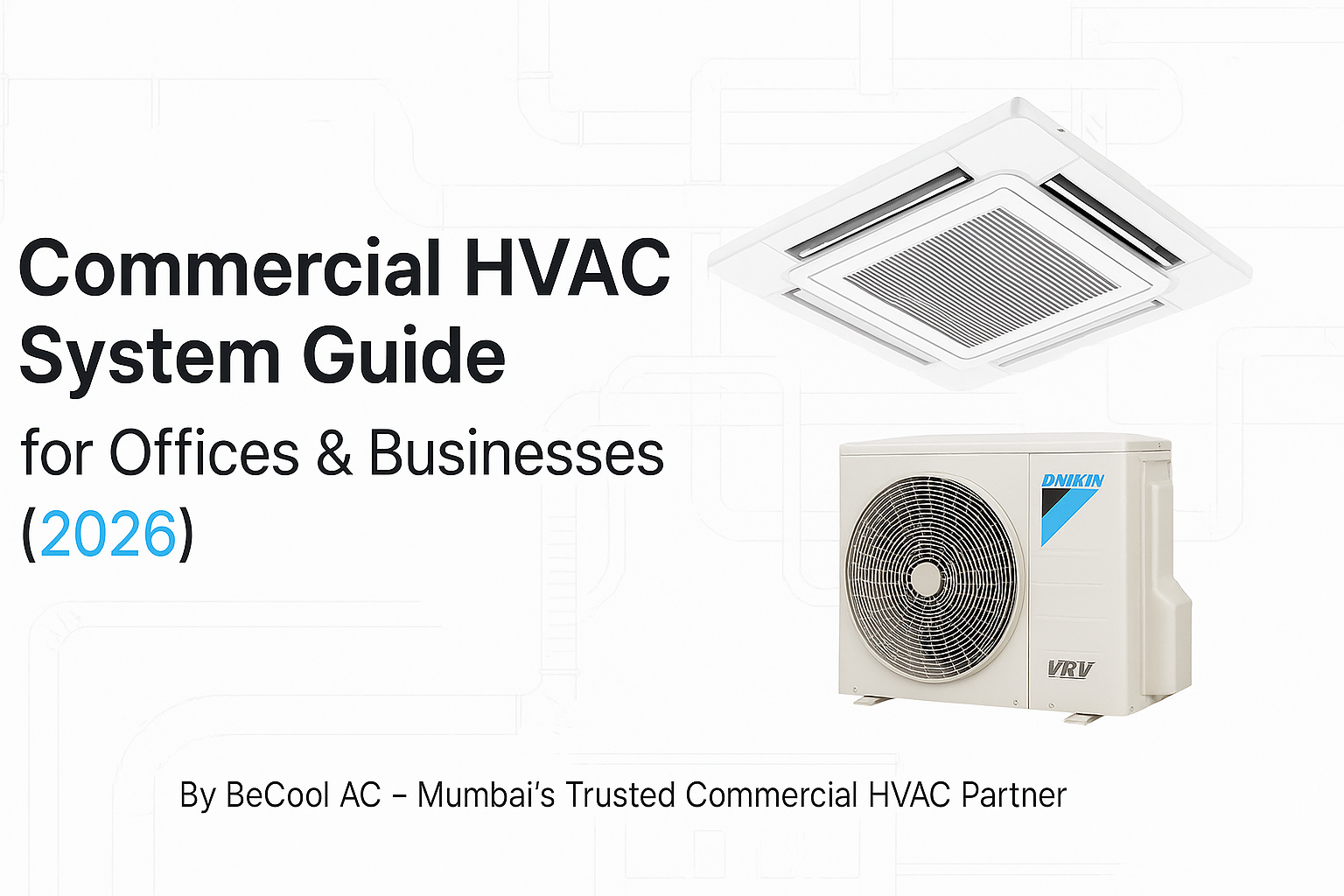
Cassette ACs offer 360° airflow from the ceiling, delivering uniform comfort without occupying wall or floor space — ideal for offices, retail, salons, clinics and classrooms.
Explore cassette solutions: Daikin Cassette AC.
3.4 Rooftop / Package Units
Used for malls, warehouses, cinema halls and industrial facilities where centralised rooftop equipment is preferred.
3.5 Chillers
Deployed in very large commercial structures, IT parks, hospitals and industrial processes that need central chilled water circuits.
3.6 Fresh Air & Ventilation Systems
Essential for restaurants, hospitals, gyms and basements to maintain fresh air, remove odours and support healthy IAQ.
4. VRV vs Ductable vs Cassette AC — Comparison
| Feature | VRV / VRF | Ductable AC | Cassette AC |
|---|---|---|---|
| Best For | Offices & multi-zone buildings | Gyms, restaurants, halls | Offices, retail, classrooms |
| Energy Efficiency | ⭐⭐⭐⭐⭐ | ⭐⭐⭐⭐ | ⭐⭐⭐ |
| Zoning | Yes (high) | Limited | No individual zoning |
| Initial Cost | High | Medium | Medium–Low |
| Ideal Project Size | Medium to large buildings | Single large halls/zones | Small to mid-size rooms |
5. How Commercial HVAC Systems Work
- Indoor units absorb heat from the room air using refrigerant coils.
- The refrigerant carries this heat to the outdoor unit via insulated piping.
- The outdoor unit releases heat into the outside atmosphere.
- Cool, treated air is circulated back into the space via ducts, cassettes or vents.
- Smart sensors and controls continuously adjust operation for comfort and efficiency.
6. Key Factors When Choosing an HVAC System
- Building layout: Number of floors, open areas, cabins and meeting rooms.
- Heat load: People density, lighting, equipment, glass façade, kitchen loads.
- Ceiling height: Higher ceilings may require higher tonnage or different diffuser design.
- Occupancy pattern: 24×7, business hours only, shift-based usage.
- Ventilation needs: Fresh air requirements for health and compliance.
- Energy-efficiency goals: Long-term operational cost vs initial budget.
- Future expansion: Possibility of adding more zones or floors later.
- Installation space: Availability of terrace, shaft, ceiling voids, etc.
7. Best HVAC System for Different Business Types
| Business Type | Recommended System | Reason |
|---|---|---|
| Corporate Offices | VRV + Cassette AC | Quiet, efficient, independent zone control |
| Restaurants & Cafés | Ductable AC + Fresh Air | Manages humidity, odours and varying load |
| Hospitals & Clinics | VRV + Ventilation | Precise temperature and cleaner air distribution |
| Gyms & Fitness Studios | Ductable AC | High airflow and strong cooling for active spaces |
| Retail Stores & Showrooms | Cassette AC | Uniform airflow with clean ceiling aesthetics |
8. Commercial HVAC Pricing in 2026
Indicative equipment pricing (excluding full project execution):
| System Type | Capacity | Price Range* |
|---|---|---|
| Cassette AC | 2.0 TR | ₹70,000 – ₹90,000 |
| Ductable AC | 5.5–6.0 TR | ₹1,30,000 – ₹2,00,000 |
| Package / Rooftop Units | 8–11 TR | ₹1,80,000 – ₹2,60,000+ |
*Final commercial HVAC pricing depends on design, ducting, controls, number of indoor units, electrical work and site complexity.
9. Real-World Example
10. Common Mistakes to Avoid
- Skipping professional heat load calculation.
- Ignoring fresh air and ventilation requirements.
- Poor placement of outdoor units with no airflow clearance.
- Choosing low-cost, low-efficiency systems that increase long-term bills.
- Not planning for service access and maintenance space.
- Operating without a regular maintenance schedule or AMC.
11. FAQs — Commercial HVAC Systems
Final Thoughts
Choosing a commercial HVAC system is a long-term investment in comfort, efficiency and business performance. With the right Daikin solution and a trusted implementation partner, your commercial space can achieve consistent cooling, better air quality and lower operating costs.
To explore customised commercial HVAC solutions for your project, visit BeCool AC.