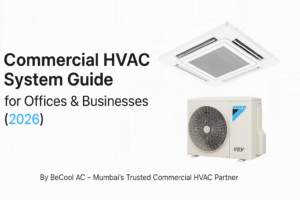
This blog explores the key differences between Daikin VRV and traditional HVAC systems, guiding you in choosing the ideal solution for your commercial space.
Table of Contents
- 1. Understanding the Core Difference
- 2. Energy Efficiency
- 3. Installation Flexibility
- 4. Cooling Comfort and Zone Control
- 5. Long Term Maintenance and Reliability
- 6. Cost Comparison
- 7. Scalability
- 8. Ideal Use Cases
- 9. Why Daikin VRV Is Becoming the Standard
- 10. Working With the Right Experts
- Final Verdict
- FAQs
When you’re responsible for designing or upgrading a commercial property—whether it’s a corporate office, retail outlet, hotel, hospital, or co-working space—choosing the right cooling system becomes a mission-critical decision. The HVAC air conditioning system you install not only affects comfort but also operating costs, long-term maintenance, and energy efficiency.
Today, most businesses contemplate between two major technologies:
Daikin VRV AC (Variable Refrigerant Volume) and Traditional HVAC systems (chillers, ductable units, and basic split/central AC setups).
Both systems have proven themselves for years, but the real question remains:
Which system gives better ROI, comfort, efficiency, and scalability for modern commercial spaces?
Let’s break it down with real-world comparisons, insights from market trends, and examples from actual commercial installations.
1. Understanding the Core Difference
What Is a Daikin VRV System?
A Daikin VRV system is an advanced, intelligent air conditioning technology where one outdoor unit can control multiple indoor units, allowing zone-based cooling, real-time energy monitoring, and superior efficiency. Daikin pioneered VRV globally, making it a trusted choice for commercial set-ups.
VRV is essentially the next evolution of the HVAC air conditioning system, built for businesses that want flexibility, energy savings, and seamless system expansion.
What Are Traditional HVAC Systems?
Traditional systems include ductable ACs, chillers, cassette units, and split ACs. They offer standard cooling, but lack zone control, automation, and the energy optimization capabilities that a VRV system HVAC provides.
2. Energy Efficiency: Where VRV Changes the Game
Energy bills often become one of the biggest expenses for commercial properties.
Here’s where Daikin VRV AC systems shine.
Why VRV Leads in Efficiency
- Variable refrigerant technology optimizes cooling based on room requirement.
- Rooms that don’t need cooling consume near-zero energy.
- Avoids the ON/OFF cycle of traditional systems—saving up to 30–40% energy annually.
A 10,000 sq. ft. corporate office in Andheri, Mumbai replaced its Ductable ACs with a Daikin commercial HVAC VRV setup. Within six months, they reported 28% reduction in electricity costs and better temperature control across multiple meeting rooms.
Where Traditional HVAC Falls Short
Traditional units cool entire zones irrespective of occupancy. Even empty rooms consume energy because ducts push air uniformly.
3. Installation Flexibility: VRV Wins for Modern Architecture
The design flexibility of VRV systems is one of the biggest reasons architects prefer them.
Advantages of Daikin VRV System Installation
- Requires minimal ducting
- Lightweight equipment makes rooftop installation simpler
- Indoor units can be customized for each zone
- Perfect for buildings with space constraints
Many modern commercial complexes in Mumbai and Thane prefer VRV because it works seamlessly with glass facades, contemporary layouts, and multi-floor structures.
Traditional HVAC Limitations
- Requires large ducting
- Higher structural load
- Difficult to modify during renovations
- Not ideal for smart offices or multi-tenant buildings
4. Cooling Comfort & Zone Control: VRV Delivers Precision
One of the biggest perks of Daikin VRV AC technology is the ability to control rooms independently.
VRV Zone Control Includes:
- Individual temperature settings
- Automated adjustments depending on occupancy
- Quiet operation
- Smart controls through apps and BMS
Imagine having a boardroom cooled at 20°C, a cafeteria at 24°C, and an empty cabin consuming zero energy—all simultaneously.
Traditional HVAC Limitation
Ductable or central systems cool everything the same way. Overcooling and uneven temperatures are common complaints.
5. Long-Term Maintenance & Reliability
VRV Maintenance Advantages
- Requires preventive maintenance, not heavy part replacement
- Modular design ensures only affected units are serviced
- Longer lifespan due to advanced compressors
Daikin’s reliability is well-known, and businesses often choose Daikin HVAC system for uninterrupted cooling and long-term durability.
Traditional HVAC Drawbacks
- Prone to breakdowns
- High repair costs
- More downtime
- Larger components require specialized technicians
Looking for reliable servicing? Connect with experienced HVAC service providers in Mumbai for annual maintenance plans.
Connect now6. Cost Comparison: VRV vs Traditional HVAC
One of the biggest questions companies ask:
Is Daikin VRV AC Price Worth It?
Upfront, VRV systems cost more than traditional AC units.
But businesses recover this investment quickly because of:
- Significant energy savings
- Lower long-term maintenance
- Extended system lifespan
- Scalable expansion without replacing the base system
Traditional HVAC Cost Structure
- Lower initial cost
- Higher electricity consumption
- Higher maintenance
- Higher long-term cost of ownership
Planning to reduce your commercial energy bills? Speak with a Daikin authorised dealer in Mumbai for a custom energy assessment.
Request an assessmentCost Comparison: Daikin VRV vs Traditional HVAC (At a Glance)
| Parameters | Daikin VRV System | Traditional HVAC System |
|---|---|---|
| Initial Cost | Higher (premium technology and components) | Lower (basic installation and units) |
| Energy Efficiency | Saves 30–40% annually due to variable refrigerant control | Consumes more energy due to constant load cooling |
| Maintenance | Low, modular, preventive-friendly | Higher, frequent servicing and part replacement |
| Scalability | Highly scalable without structural changes | Low scalability; major redesign needed |
| Comfort Control | Advanced zone-based cooling, automation | Uniform cooling, no independent control |
| Long-Term ROI | Recoverable within 2–4 years | Higher operating cost leads to long-term expense |
| Best For | Smart offices, hotels, hospitals, multi-floor commercial buildings | Large halls, warehouses, fixed cooling requirement spaces |
Commercial properties that switched to VRV systems usually recover initial costs within 2–4 years, depending on usage.
7. Scalability: VRV Is Built for Future Growth
If you plan to expand your workspace, add floors, or upgrade interiors, VRV offers unmatched scalability.
- Add indoor units anytime
- Expand cooling capacity without major infrastructure changes
- Upgrade to smart controls easily
Traditional HVAC systems, however, require extensive redesigning for expansions.
8. Ideal Use Cases: Which System Fits Your Commercial Space?
Choose Daikin VRV If You Want:
- Energy savings
- Smart automation
- Zone-based cooling
- Low maintenance
- Long-term ROI
- Clean aesthetics
- Reliability backed by top Daikin HVAC dealers
Choose Traditional HVAC If You Need:
- Large uniform cooling
- Lower upfront investment
- Heavy industrial cooling needs
- Less focus on energy optimization
9. Why Daikin VRV Is Becoming the Standard in Modern Commercial Buildings
Market trends show that more than 60% of new commercial spaces in urban India are moving toward VRV/VRF technology because:
- It supports sustainable energy goals
- It delivers higher comfort and smaller carbon footprint
- It aligns with smart building standards
VRV is no longer a luxury—it’s becoming the benchmark for premium commercial HVAC systems.
10. Working With the Right Experts Makes All the Difference
Whether you choose VRV or traditional, you need experienced experts for installation, load calculation, and system design.
Businesses in Mumbai often prefer installing VRV through trusted professionals such as:
- Daikin authorised dealer in Mumbai
- Daikin-certified technicians
- Trusted HVAC service providers in Mumbai
- Experienced Daikin HVAC dealers
This ensures correct system sizing, efficient installation, and long-term reliability.
Ready to explore the right HVAC solution for your commercial space? Connect with Mumbai’s trusted Daikin specialists today.
Get expert guidanceFinal Verdict: Daikin VRV vs Traditional HVAC – Which Is Best?
Choosing between a Daikin VRV system and a traditional HVAC setup comes down to how future-ready and efficient your commercial space needs to be. Modern businesses expect flexible layouts, precise temperature control, and lower long-term operating costs from their HVAC air conditioning system, and in these areas, Daikin VRV technology consistently stands ahead. Its zone-based cooling, energy efficiency, and adaptability to evolving workspace requirements make it ideal for today’s dynamic commercial environments.
Traditional HVAC systems still work well for large uniform cooling needs, but they fall short when spaces require personalization, automation, and sustainability. With growing expectations for comfort and optimized performance, most commercial projects now prefer VRV as the smarter long-term investment. And when it comes to reliable execution and installation expertise, BeCool AC stands out as one of Mumbai’s trusted Daikin specialists, ensuring your commercial HVAC project is designed with precision and long-term performance in mind.